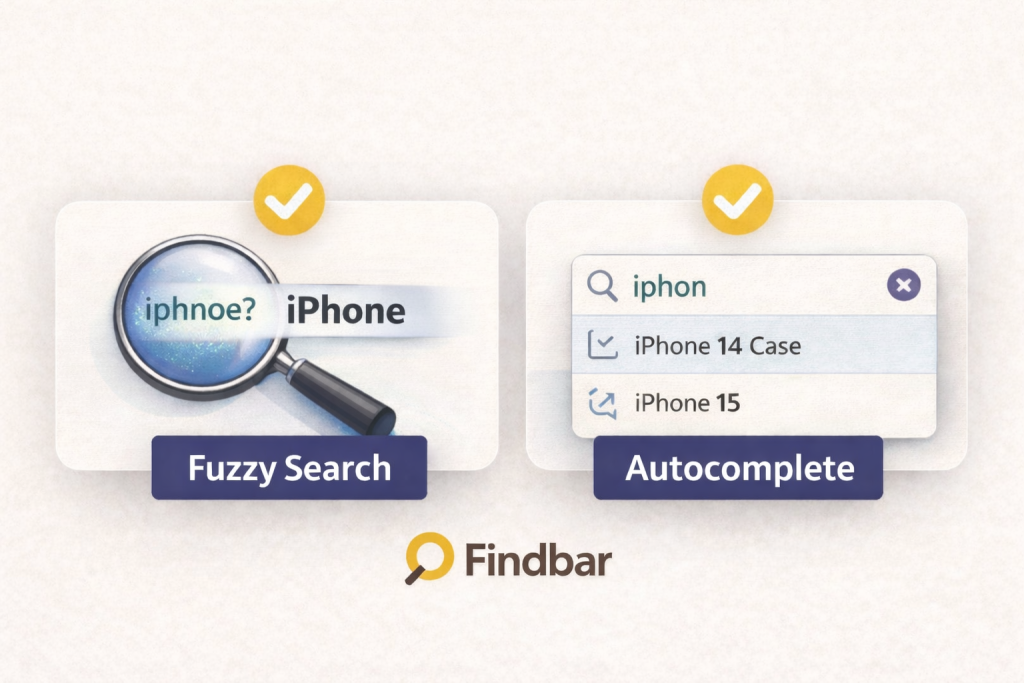
If you run an eCommerce store, you already know the problem. Users search with typos, incomplete words, different spellings, or slightly wrong product names.
Traditional keyword search treats those queries as errors. Fuzzy search treats them as intent.
Fuzzy search is a search technique that returns relevant results even when the search query is not an exact match to the indexed data.
It is designed to tolerate mistakes and variations in how users type, spell, or phrase what they are looking for.
In simple terms. Fuzzy search answers the question “What did the user probably mean?” instead of “Did they type the exact right word?”
Why Exact-Match Search Fails in Real Life
Exact-match search assumes users behave perfectly. They do not.
Real users:
- Misspell product names
- Use singular instead of plural and the opposite
- Type too fast on mobile
- Use abbreviations or partial terms
- Do not know the exact product naming used in your catalog
Examples:
- “nik air max” instead of “nike air max”
- “iphon 14 case” instead of “iphone 14 case”
- “shampo dry hair” instead of “shampoo for dry hair”
Without fuzzy search, these queries often return zero results or irrelevant results.
That creates frustration and lost revenue.
With fuzzy search, the system understands that these queries are close enough and returns the correct products.
How Fuzzy Search Works. Conceptually
Fuzzy search works by measuring how similar two strings are. The most common approach is to calculate how many small edits are needed to turn the user’s query into a known word or phrase.
Those edits can include:
- Replacing a letter
- Removing a letter
- Adding a letter
- Swapping letters
If the difference between the query and a known term is within an acceptable threshold, the system considers it a match.
For example:
- “iphnoe” → “iphone”
- “addiddas” → “adidas”
- “snikers” → “sneakers”
Modern implementations go beyond simple spelling distance. They also combine fuzzy matching with:
- Token matching
- Prefix matching
- Context and category awareness
- Behavioral signals
This is where fuzzy search becomes truly effective in commerce environments.
Fuzzy Search vs Autocomplete vs Synonyms
These features are often confused. They solve different problems.
Fuzzy search handles mistakes and small deviations in spelling or typing.
Autocomplete helps users complete a query faster while they are typing.
Synonyms handle different words with the same meaning. For example “sofa” and “couch”.
A strong on-site search experience uses all three together. Fuzzy search ensures users do not hit dead ends. Autocomplete speeds up discovery. Synonyms expand relevance.
Why Fuzzy Search Is Critical for eCommerce
Search users convert better than browsing users. But only if they find what they want.
Fuzzy search directly impacts:
- Search success rate
- Zero-result queries
- Conversion rate
- Revenue per search session
In large catalogs, even a small increase in search success can unlock significant revenue.
Especially on mobile, where typing accuracy is lower and patience is shorter.
Retailers that rely only on exact matching are effectively penalizing real user behavior.
Common Mistakes With Fuzzy Search
Fuzzy search is powerful. But when implemented poorly, it can hurt relevance.
Typical mistakes include:
- Being too aggressive, returning unrelated products
- Ignoring category context
- Applying fuzzy matching equally to all terms
- Not combining it with relevance and behavioral ranking
Good fuzzy search is configurable. It adapts to product types, query length, and user intent. It is not a blunt instrument.
Fuzzy Search in Modern AI-Powered Discovery
Modern on-site search platforms do not treat fuzzy search as a standalone feature. It is part of a broader discovery system that understands intent, behavior, and catalog structure.
In platforms like Findbar, fuzzy search is combined with:
- Semantic understanding
- Behavioral ranking
- Visual discovery
- Fallback logic for complex queries
This means users get relevant results even when:
- The query is imperfect
- The wording does not match catalog taxonomy
- Multiple errors exist in a single query
The goal is simple. Never let a user hit a dead end because of how they typed.
The Business Impact. Why This Actually Matters
From a business perspective, fuzzy search is not a “nice to have”. It is a revenue safeguard.
When fuzzy search is implemented correctly:
- Fewer searches return zero results
- More users stay engaged instead of bouncing
- Search usage increases
- Conversion rates from search improve
In competitive eCommerce environments, these gains compound fast.
Fuzzy search is about respecting real human behavior.
People do not search perfectly. Your search engine should not expect them to.
If your on-site search still relies heavily on exact matching, you are losing opportunities every day.
Fuzzy search closes that gap by turning imperfect queries into successful product discovery.
And in eCommerce, better discovery almost always means better revenue.